Spicy Burger: The Handwritten Font That Brings Uncommon Elegance to Modern Design
Typography has always been more than the sum of its letterforms. The right typeface doesn't just communicate words — it communicates feeling, intention, and identity before a single sentence is fully read. Among the growing constellation of handwritten fonts available to designers today, one name has been generating a quiet but persistent buzz across studios, freelance circles, and creative marketplaces: Spicy Burger. Despite its playful name, this typeface delivers a level of refinement that feels anything but casual. It has become a go-to asset for professionals who need their work to convey warmth, personality, and a bespoke sense of craft.
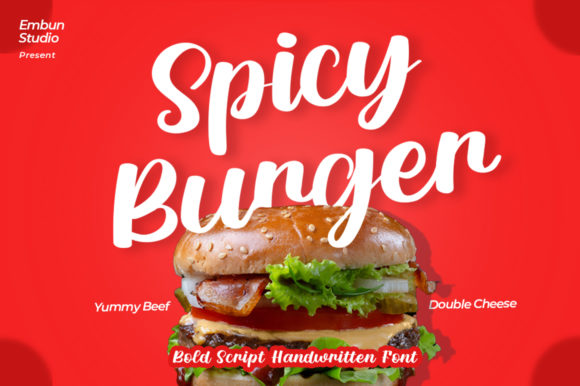
What makes Spicy Burger remarkable is not simply that it mimics handwriting. Many fonts attempt that and end up feeling mechanical or repetitive. Instead, Spicy Burger succeeds because it understands the rhythm of the human hand. Its varying baseline, smooth lines, gorgeous glyphs, and stunning alternates combine to create an illusion so convincing that recipients often pause and ask whether the text was penned by hand. That question — was this made just for me? — is precisely the reaction that drives its growing popularity.
The Rise of the Handwritten Aesthetic in a Digital-First World
We live in an era dominated by digital precision. Grids, templates, and automated design tools have made clean layouts accessible to nearly everyone. But accessibility has a side effect: sameness. As polished as many modern designs are, they can feel sterile. Consumers and clients alike have begun craving imperfection — not sloppiness, but the kind of organic irregularity that signals human involvement. This shift explains why handwritten fonts have surged in relevance. They reintroduce the warmth that pixel-perfect precision often strips away.
Spicy Burger sits comfortably at the intersection of this cultural shift and practical design needs. It doesn't abandon legibility for the sake of aesthetic flourish. Its smooth lines remain readable at multiple sizes, which makes it versatile across both print and digital applications. The varying baseline — a deliberate design choice — gives each line of text a gentle, rhythmic movement that draws the eye naturally across the page. In a world where attention spans are shrinking, that kind of visual flow is a subtle but powerful advantage.
The broader market has taken notice. Stationery designers, branding agencies, and independent creators are all reporting increased client demand for designs that feel personal rather than produced. Wedding suites, in particular, have become a proving ground for fonts like Spicy Burger. Couples no longer want invitations that look like they came from a template. They want something that feels storied, intimate, and unmistakably theirs. A font with stunning alternates and contextual glyphs allows designers to build that bespoke feeling without starting from scratch on every project.
What Sets Spicy Burger Apart from Other Script Fonts
The script font category is crowded. A quick browse through any type marketplace reveals hundreds of options, many of which blur together after a few minutes of scrolling. So why has Spicy Burger captured attention in a saturated space? The answer lies in execution and restraint.
Many handwritten fonts overplay their hand. They lean too heavily on exaggerated swashes, inconsistent spacing, or flourishes that distract more than they enhance. Spicy Burger takes a more measured approach. Its gorgeous glyphs are ornamental without being ostentatious. The alternates — those alternate character forms that allow designers to swap one version of a letter for another — are plentiful enough to create variety but cohesive enough to maintain a unified voice. This balance is difficult to achieve and even harder to sustain across an entire character set.
Another distinguishing factor is how the font handles baseline variation. In natural handwriting, letters don't sit on a perfectly straight line. They bounce slightly, rise and fall in subtle ways that signal speed, pressure, and mood. Spicy Burger replicates this phenomenon with remarkable fidelity, but it does so without sacrificing the structural integrity of each letterform. The result is text that feels alive — not chaotic, but breathing. For designers working on emotionally resonant projects, that quality is invaluable.
The Technical Craft Behind the Elegance
Beneath the aesthetic appeal of Spicy Burger lies a foundation of careful type design. Smooth lines don't happen by accident. Each curve has been drawn, tested, and refined to ensure that the font performs consistently across different software environments, screen resolutions, and print processes. The glyph set extends well beyond basic Latin characters, giving designers access to ligatures, swashes, and stylistic alternates that can transform a simple wordmark into something truly distinctive.
OpenType features play a significant role here. When used in compatible software like Adobe Illustrator, InDesign, or even modern web browsers, Spicy Burger can automatically substitute certain letter combinations with more elegant variants. This means a designer can type out a line of text and watch as the font intelligently applies contextual alternates, creating connections between letters that feel organic and unforced. For logo design, this capability is transformative. A business name set in Spicy Burger can achieve a custom-lettered look without the time and expense of commissioning hand-drawn lettering from scratch.
Practical Applications Across Creative Industries
The versatility of Spicy Burger extends well beyond the wedding stationery suite, though that remains one of its most popular use cases. Designers across multiple disciplines have discovered that the font adapts gracefully to a wide range of contexts. Understanding where and how to deploy it effectively can open new creative possibilities.
- Wedding Invitations and Thank You Cards: The font's elegant alternates and smooth flow make it ideal for formal yet personal stationery. Envelope addressing, place cards, and ceremony programs all benefit from the handwritten touch Spicy Burger provides.
- Branding and Logo Design: Boutique businesses — from bakeries and florists to wellness coaches and photographers — use Spicy Burger to build brand identities that feel artisanal and approachable. The font's ability to mimic custom lettering gives small businesses a premium look on a realistic budget.
- Greeting Cards and Quote Graphics: Social media content creators and print designers alike use the font for inspirational quotes, seasonal greetings, and personal messages. The varying baseline adds visual interest that static, uniform typefaces simply cannot match.
- Business Cards and Collateral: A name or tagline set in Spicy Burger immediately softens the formality of a business card, creating a memorable tactile impression that recipients associate with thoughtfulness and care.
- Packaging Design: Artisanal food brands, candle makers, and skincare companies have embraced handwritten fonts for labels and packaging. Spicy Burger, with its smooth lines and elegant proportions, lends a sense of craft and authenticity that resonates with consumers seeking products with a human story behind them.
What connects all these use cases is a shared desire to communicate personality. In each scenario, Spicy Burger bridges the gap between the designer's vision and the audience's emotional response. It doesn't just display words — it infuses them with warmth, movement, and intent.
Changing Workflows and the Demand for Efficient Elegance
The modern creative professional operates under constant time pressure. Client turnaround expectations have shortened, project volumes have increased, and the gig economy has pushed many designers to optimize every aspect of their workflow. In this environment, fonts that deliver outsized impact with minimal effort become essential tools rather than optional indulgences.
Spicy Burger fits squarely into this paradigm. Its extensive glyph set and OpenType features allow a designer to achieve in minutes what might otherwise take hours of manual lettering or painstaking vector editing. By simply activating stylistic alternates or ligatures, the designer can introduce variation that feels curated and intentional. This efficiency doesn't compromise quality — it enhances it by freeing up creative energy for higher-level decisions about composition, color, and concept.
There is also a growing expectation among clients for authenticity in branding. Consumers have become adept at detecting stock imagery, generic templates, and mass-produced aesthetics. They gravitate toward brands that feel real, personal, and grounded. A handwritten font like Spicy Burger signals that a brand values the human touch, even when that touch is mediated by digital tools. It's a subtle cue that can influence perception and, ultimately, purchasing behavior.
Spicy Burger in the Context of Design Trends
Looking at the broader currents shaping visual culture, the popularity of Spicy Burger reflects several converging trends. The first is the neo-artisanal movement, which has seen consumers gravitate toward handmade goods, small-batch production, and experiences that feel crafted rather than manufactured. Typography that evokes handwriting aligns naturally with these values. It suggests that care has been taken, that a real person was involved in the making of something.
The second trend is the maximalist revival in graphic design. After years of flat, minimalist dominance, designers are reintroducing ornament, texture, and expressive typography into their work. Spicy Burger, with its flowing alternates and decorative potential, provides a way to embrace this maximalist impulse without losing coherence. It adds richness without becoming chaotic.
Third, the rise of personal branding has created an enormous market for fonts that help individuals differentiate themselves. Entrepreneurs, coaches, content creators, and freelancers all need visual identities that feel distinctive and memorable. A carefully chosen handwritten font can become a signature element of that identity — recognisable, repeatable, and emotionally resonant.
Observations from the Field
Designers who have incorporated Spicy Burger into their projects often note how well it pairs with other typefaces. A clean sans-serif for body copy alongside Spicy Burger for headlines or accent text creates a dynamic interplay between structure and spontaneity. This contrast is effective across both print layouts and digital interfaces, where readability must be balanced with personality.
Another common observation concerns client response. Stationers report that wedding clients frequently express delight upon seeing their names rendered in the font — often asking whether the lettering was done by hand. That moment of delighted uncertainty is a testament to the font's quality. It fulfills the fundamental purpose of a handwritten typeface: to blur the line between mechanical reproduction and personal creation.
Web designers have also begun exploring ways to bring Spicy Burger into digital spaces through @font-face embedding and variable font technologies. While handwritten fonts can present legibility challenges at small sizes on screens, when used judiciously — for hero headings, pull quotes, or brand signatures — they inject personality into otherwise utilitarian interfaces. The key is restraint. A little handwritten warmth goes a long way in a digital context, and Spicy Burger's elegant proportions make it well-suited to these selective applications.
Choosing and Using Handwritten Fonts Thoughtfully
For professionals considering adding Spicy Burger to their typographic toolkit, a few practical considerations can maximize its impact. First, pay attention to the context. Handwritten fonts carry strong emotional connotations, and using them in the wrong setting — a corporate annual report, for instance — can feel jarring rather than appealing. Match the font's personality to the message and the audience.
Second, explore the full character set before committing to a design direction. The alternates and ligatures built into Spicy Burger are part of what makes it exceptional, but they only reveal their value when designers take the time to experiment. A single word set in the default character forms may look pleasant; the same word with carefully selected alternates can look extraordinary.
Third, consider pairing strategies. Handwritten fonts shine brightest when contrasted with something grounded. A neutral sans-serif or a classic serif can provide the structural anchor that allows Spicy Burger's fluid lines to stand out without overwhelming the composition.
The Enduring Appeal of the Handwritten Word
There is something deeply human about handwriting. It carries the imprint of a person — their speed, their pressure, their mood. In an age of automated everything, the presence of the handwritten gesture feels like a small act of resistance against impersonality. Spicy Burger captures this feeling with uncommon grace. It doesn't just look like handwriting; it feels like it, moving across the page with the kind of natural irregularity that machines usually erase.
That emotional resonance is why the font has found a home in so many different corners of the creative world. Wedding designers use it to craft invitations that couples treasure for decades. Brand strategists use it to build identities that feel genuine. Small business owners use it to signal that their work is made with care, not churned out by algorithm. In each case, the font does something that purely mechanical type cannot — it connects.
As design tools continue to evolve and artificial intelligence reshapes creative workflows, the value of the human touch will only grow. Fonts like Spicy Burger remind us that elegance doesn't require rigidity, that beauty often lives in the slight wobble of a baseline, and that the most memorable designs are the ones that feel like they were made by someone who cared. For the professionals, creators, and entrepreneurs shaping the visual landscape of tomorrow, that's a message worth setting in beautiful type.